

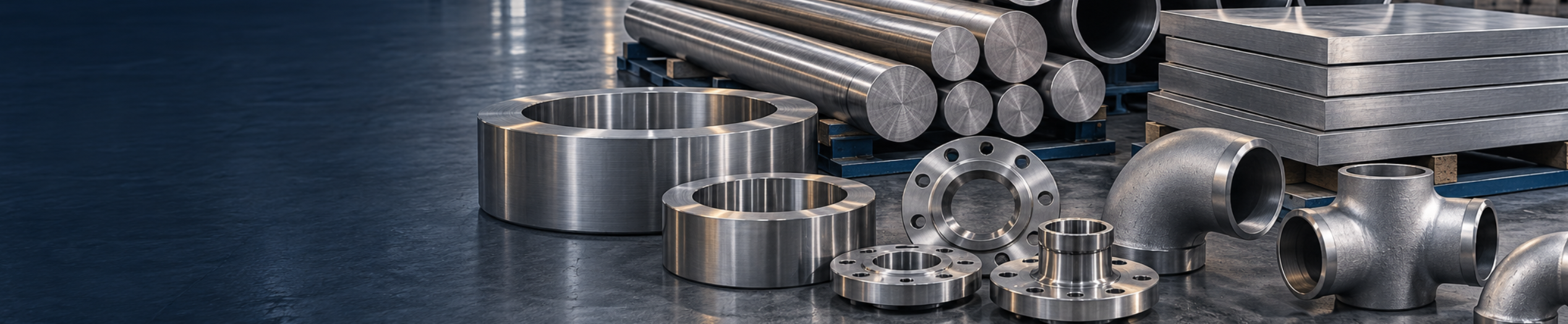
For offshore oil and gas valve manufacturers, a material decision affects much more than the purchase price of a forging or bar. It influences pressure integrity, machining, sealing performance, inspection and the cost of maintaining equipment in a difficult-to-access location.

Nickel alloy material solutions work best when the alloy, product form and delivery condition are matched to the specific valve component. A pressure-containing body, a highly loaded stem and a wetted seat do not necessarily need the same material.
Start with the valve’s service environment
“Offshore service” is not a complete material specification. A topside process valve, a seawater utility valve and a subsea production valve can face very different conditions. Separate external seawater exposure from the process fluid inside the valve, then identify which surfaces are wetted during operation, shutdown and testing.
- Fluid chemistry: water content, chlorides, pH, H₂S, CO₂ and treatment chemicals.
- Operating envelope: design temperature and pressure, startup, shutdown and upset conditions.
- Local exposure: stagnant cavities, crevices beneath seals, flow velocity and solids.
- Mechanical duty: stem torque, cyclic loads, contact stress and required toughness.
This information provides a better starting point than choosing the alloy with the highest strength or the largest nickel content.
Nickel alloys to consider for offshore valve components
The following table is a starting point for engineering review, rather than an approved substitution list. Component examples indicate possible selection paths; final acceptance depends on the valve design, construction standard and service conditions.
| Alloy / UNS | Reason to evaluate it | Selection point |
|---|---|---|
| Alloy 625 / N06625 | Corrosion-resistant wetted parts and offshore equipment | Match annealing condition and product specification to the component. |
| Alloy C-276 / N10276 | Aggressive chloride-bearing or chemically demanding wetted service | Check the actual fluid mixture, temperature and crevice exposure. |
| Alloy 718 / N07718 | Strength-driven parts such as stems or fasteners, where approved | Strength alone does not establish seawater or sour-service suitability. |
| Alloy 400 / N04400 | Selected seawater-system components | Review stagnation, deposits and local corrosion conditions. |
| Alloy K-500 / N05500 | Selected nickel-copper components requiring greater strength | Age-hardening condition and cracking susceptibility need specific review. |
Alloy 625 is a nickel-chromium-molybdenum-niobium alloy used in offshore and seawater-exposed equipment. Its combination of corrosion resistance and mechanical properties makes it a useful candidate for evaluation. The delivery condition matters: a grade designation alone does not define the material’s complete properties.
Alloy C-276 offers strong resistance to chloride-related pitting, crevice attack and stress corrosion cracking. It may be worth evaluating when the process chemistry is particularly demanding. Published corrosion data still need to be interpreted against the actual operating environment.
Alloy 718 requires a separate corrosion review even when its strength is attractive. Special Metals’ aqueous-corrosion handbook reports lower seawater crevice-corrosion resistance for 718 than for 625 and 725. For Alloy 400 and K-500, flowing seawater performance should not be generalized to stagnant or fouled conditions. K-500’s age-hardening response provides higher strength, but it is not a universal upgrade for every wetted component.
Choose the material route by component
Bodies and bonnets: confirm the pressure-boundary design requirements, material specification, forging or casting route, heat treatment and inspection access. Wrought-alloy data should not be used automatically to qualify a casting or weld deposit.
Stems and shafts: discuss torque, straightness, machining allowance, final surface finish and the specified mechanical condition. A change in heat treatment can affect both machining and the finished part’s acceptance.
Balls, seats and other trim: evaluate the contacting material pair and any surface treatment alongside corrosion resistance. Galling, wear and sealing performance are assembly issues; an alloy designation alone cannot establish them.
Fasteners: define preload, strength, toughness and environmental exposure. Avoid treating a high-strength fastener material as interchangeable with a corrosion-resistant pressure-boundary material.
Sour-service requirements must be defined in the purchase order
Where the project invokes NACE MR0175 / ISO 15156 for H₂S-containing production environments, specify the applicable edition and project requirements. ISO 15156 addresses material selection and qualification for cracking resistance; it supplements the relevant design requirements.
A statement such as “nickel alloy” or “NACE material” is not sufficient for procurement. Ask the responsible materials engineer to confirm the permitted material condition, applicable hardness or strength restrictions, environmental limits and any qualification testing. Changes in heat treatment, cold work or fabrication should be reviewed against those requirements.
Plan inspection and traceability before machining
Agree the inspection and test plan while the raw-material order is being placed. Discovering a missing requirement after machining can create avoidable rework and delays.
- Identify the governing product specification and revision.
- Define heat-treatment condition and required mechanical tests.
- Specify dimensional tolerances, surface condition and machining allowance.
- Agree ultrasonic or other nondestructive testing methods and acceptance criteria where required.
- Define chemical verification, hardness checks and any corrosion testing.
- State the required material certificate, traceability and witness or hold points.
Positive material identification can help verify alloy chemistry, but it does not replace mechanical testing, heat-treatment records or project-specific qualification. Maintain identification when bars or forgings are cut into individual blanks.
A practical RFQ checklist for valve manufacturers
For a focused quotation, send the component drawing or raw-material dimensions together with the alloy/UNS designation, product specification, quantity and delivery condition. Include the service environment, required tests, certification level, delivery schedule and any customer-approved material list.
If the grade has not yet been finalized, identify the candidate materials and the decision that needs support. This allows the technical discussion to address the real tradeoff: corrosion exposure, strength, manufacturability or documentation.
Material supply support from Phoenix Alloy
Shanghai Phoenix Alloy works with valve manufacturers on nickel alloy material enquiries, with export coordination through our Shanghai office and manufacturing support from Jiangsu Xinhua Alloy. Discuss your requirements for bars, forgings and related material forms with our team; the available route, testing scope and delivery schedule will be confirmed against your specification.
Explore our nickel alloy product range and manufacturing and inspection capabilities, or request a quotation for offshore valve materials.
Technical references
- VDM Metals: Alloy 625 characteristics and offshore applications.
- Haynes International: C-276 corrosion and fabrication data.
- Special Metals: High-Performance Alloys for Resistance to Aqueous Corrosion.
- ISO: ISO 15156-3:2020 scope and publication information. Use the edition specified by your project.